The Democratic Republic of the Congo (DRC) is a country with a population of approximately 110 million inhabitants, half of whom are children (<18 years). Kinshasa, the capital of the DRC, is an urban city of approximately 18 million inhabitants located in the southwest part of the country.
In the DRC, kidney diseases in children are frequently regarded as a death sentence due to many factors, including poverty, limited knowledge on pediatric kidney diseases, and lack of an appropriate program for screening and follow-up of kidney diseases. Populations at high-risk of kidney diseases comprise children with sickle cell anemia (SCA).
SCA is the most frequent inherited hemoglobin disorder and represents a significant public health problem in DRC. Kidney complications are a leading cause of death in young adults with SCA. Despite the contribution of SCA to the high morbidity and mortality in DRC, SCA-associated kidney complications are poorly recognized in the pediatric population. Importantly, children with SCA who develop kidney disease experience poor survival and outcomes.
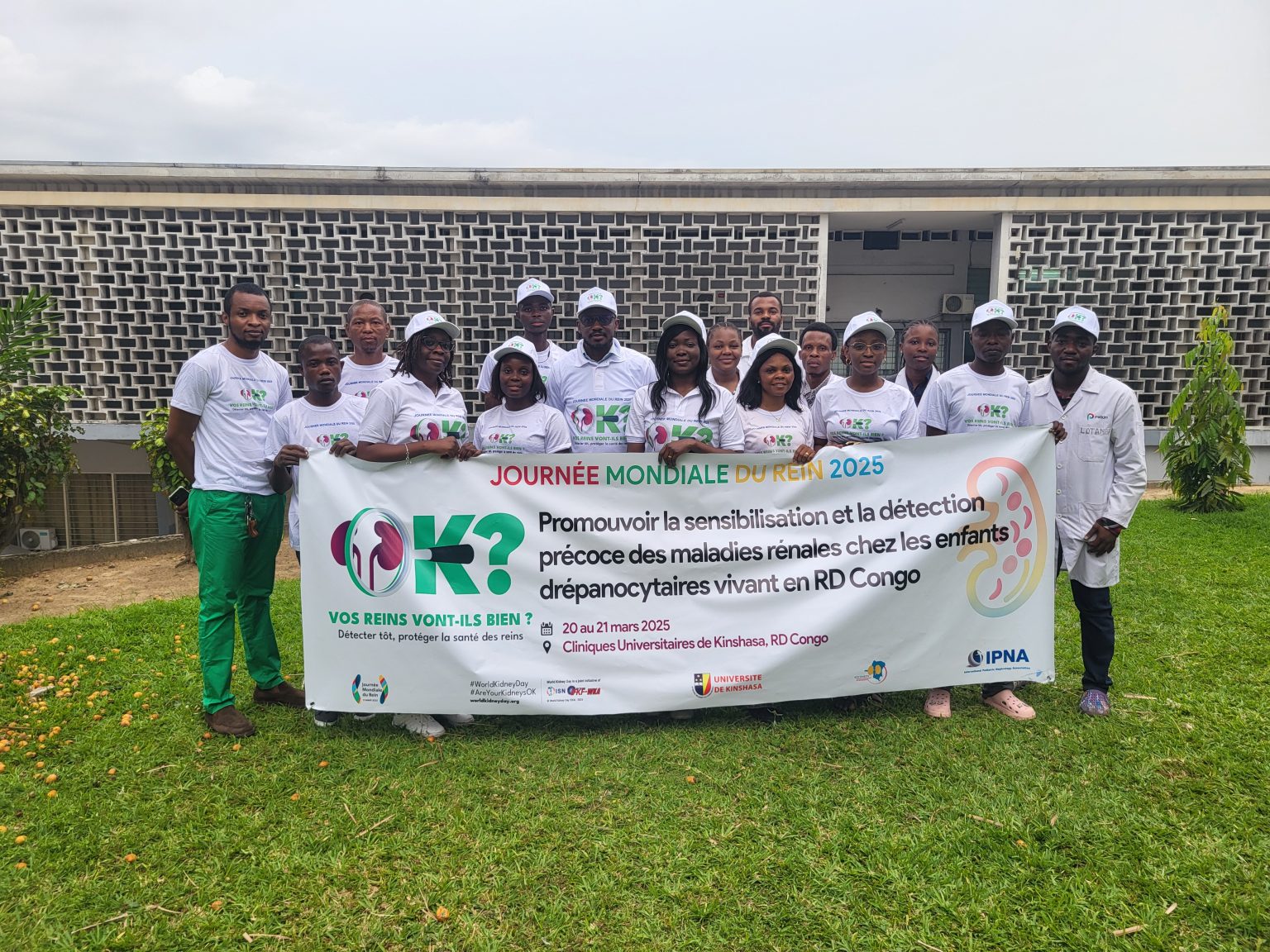
Without appropriate treatment, kidney diseases progress towards kidney failure, whose treatment requires kidney replacement therapy (KRT), which is generally unavailable or out-of-pocket in this resource-limited country. Through the World Kidney Day (WKD) 2025 campaign, we organized a serie of activities to raise community awareness and promote early detection of pediatric kidney diseases, especially in high-risk populations of children with SCA.
1. Awareness campaigns
On Day 1 (March 14th, 2025), we performed an awareness talk with parents and children (around 30) visiting our Department and those with kidney diseases (AKI survivors, nephrotic syndrome) who are being followed up in our Pediatric Nephrology Service. We educated them about kidneys and their diseases in children using the local language, a medical doll (showing the kidneys and urinary tract), and leaflets. Importantly, for children with kidney diseases being followed up in our Service, we emphasized on the adherence to long-term kidney follow-up in order to prevent or delay the progression to kidney failure. Leaflets summarizing the “eight golden rules to protect the kidney” were distributed to all participants.
On Day 3 (March 21st, 2025), an awareness talk targeting children with SCA and their parents was organized at our Department. The aim was to educate the participants on the importance of kidney disease screening and follow-up in children with SCA. Using the local language and a medical doll (showing the kidneys and urinary tract), we taught them about the early signs and common causes of pediatric kidney diseases in our country (especially sickle cell anemia, severe malaria, HIV infection, sepsis, gastroenteritis, overuse of herbal medicines and non-steroidal anti-inflammatory drugs). In addition, we emphasized the importance of seeking nephrology care when a child is sick and presents common signs of kidney disease such as edema, oliguria or anuria, and “tea or coca cola” colored urine. This event was attended by around 150 children and more than 100 parents. At the end of the campaign, leaflets on “the kidney and its disease in children” were distributed to all participants.
2. Workshop with healthcare providers
On Day 2 (March 20th, 2025), we organized a workshop attended by more than 100 healthcare providers (general practitioners, pediatric trainees, pediatricians, nurses, and medical students), especially those following children with SCA. Welcome words were given by Dr. Léopold Nzambimpungu (Representative of the National sickle cell disease control program of the DRC), Prof. Dr. Nazaire Nseka (President of the Congolese Society of Nephrology), and Prof. Dr. Pépé Ekulu (Head of the Pediatric Nephrology Service at the University Hospital of Kinshasa).
Subsequently, Prof. Dr. Agathe Nkoy, the keynote speaker, delivered a presentation on the “Early detection and management of kidney diseases in children with SCA”. The main take-home message was to integrate kidney disease screening and follow-up in the routine management of children with SCA living in the DRC. A fruitful discussion with the participants followed the presentation. At the end of the workshop, leaflets containing a practical approach for the screening, follow-up, and management of kidney diseases in children with SCA were distributed to all participants.
Importantly, with the support of the National sickle cell disease control program of the DRC, a chapter dedicated to kidney disease screening and follow-up will be integrated into the National Guidelines for the management of patients with sickle cell disease.
3. Screening campaign
On Day 3 (March 21st, 2025), a screening camp was organized at the University Hospital of Kinshasa for children with SCA aged 2-18 years and their controls (children not diagnosed with SCA from the nuclear family, extended family, or household area). Children were screened for hypertension, urinary tract infection, and early manifestations of kidney diseases (proteinuria, albuminuria, hematuria).
4. Interview with local media
All the activities were broadcast on local media. In addition, an interview was held to raise community awareness about kidney health and kidney complications in SCA. The main message was that kidney diseases in children are common in our country, especially in children with SCA. Early detection and prevention of kidney disease are crucial in managing patients with SCA and improving their health outcomes.
Furthermore, on the last day of the event, a parent gave a testimony about the journey of his kid, as an AKI survivor, followed up in our Pediatric Nephrology Service. The child presented an AKI due to severe malaria and underwent peritoneal dialysis in our Service. The key message of this testimony was to advise parents to seek medical care early when the child is sick since many causes of AKI in our setting are preventable.



World Kidney Day
ISN – Global Operations Center
Avenue des Arts 1-2, 6th floor,
1210, Brussels, Belgium
Tel +32 2 808 04 20
[email protected]